
Why Strong Students Still Fail Undergraduate Video Interviews
Undergraduate video interviews are one of the most decisive stages of Canadian admissions. This article explains why strong applications fail on camera, how universities evaluate video interviews, and what applicants must do to perform clearly and confidently under time pressure.

Introduction
Undergraduate video interviews are often the final hurdle in competitive Canadian admissions processes. Applicants may have strong grades, rigorous coursework, impressive extracurricular involvement, and thoughtful written applications, yet still receive rejections after the video interview stage.
For many students, this outcome is unexpected. Video interviews appear simple: short questions, limited response time, and familiar topics such as motivation, leadership, or reflection. Compared to exams or essays, they seem low risk.
In reality, undergraduate video interviews are among the most decisive filtering tools universities use.
Admissions committees rely on video interviews not to confirm academic ability, but to evaluate how applicants think, communicate, and perform under time pressure. At this stage, strong credentials are assumed. What differentiates applicants is performance.
Why Universities Use Video Interviews Instead of Live Interviews
Video interviews allow universities to evaluate large applicant pools consistently and efficiently. More importantly, they introduce a controlled level of pressure that reveals qualities traditional interviews often fail to capture.
Unlike live interviews, video interviews remove conversational cues, feedback, and flexibility. Applicants must organize their thoughts independently, speak clearly without prompts, and manage time precisely. This structure is intentional.
From an admissions perspective, video interviews answer questions that transcripts and essays cannot:
- Can the applicant communicate clearly without guidance
- Can they structure ideas under time constraints
- Do they sound authentic rather than rehearsed
- Can they reflect thoughtfully without over polishing
Video interviews are not about charisma. They are about clarity, judgment, and composure.
The Structural Mismatch Between Academic Success and Video Interview Performance
Most students are trained to succeed in environments that reward preparation, revision, and extended explanation. Essays can be edited. Exams allow time to think silently. Teachers often guide discussion.
Video interviews remove all of these supports.
Applicants are given limited preparation time and a fixed response window, often between 60 and 90 seconds. There is no opportunity to restart, clarify, or adjust. Students must think aloud in real time while being recorded.
This creates a structural mismatch. Students who excel academically often struggle to:
- Prioritize ideas quickly
- Speak concisely without rambling
- Commit to a clear message
- Avoid sounding scripted
Video interviews are not testing knowledge. They are testing communication under constraint.
How Admissions Committees Actually Evaluate Video Interviews
Despite variation across universities and programs, video interview evaluation tends to converge around a consistent set of observable behaviours.
Admissions committees primarily assess:
- Thought structure and clarity
- Ability to answer the question directly
- Communication confidence under time pressure
- Authenticity and self awareness
- Reflection and maturity
The content of an answer matters less than how effectively it is delivered. Two applicants may describe similar experiences and receive very different evaluations based on focus, organization, and composure.
Sounding impressive is less important than sounding coherent and genuine.
Why High Achieving Students Are Especially at Risk
Strong students often underperform in video interviews because their preparation strategies are mismatched to the format.
Many rely on scripting. They write answers in advance and attempt to memorize them. Under recording pressure, these scripts often collapse. Students forget lines, rush delivery, or sound robotic.
Others overthink. They attempt to include too much detail, lose structure, and run out of time. Some hesitate excessively, afraid of saying the wrong thing.
Three patterns appear repeatedly among academically strong but video interview weak applicants:
- Over prepared answers that sound unnatural
- Long responses without a clear point
- Visible nervousness despite strong content
These issues are rarely corrected through written practice alone.
What Video Interviews Are Designed to Reveal
Video interviews are designed to surface how applicants handle mild stress without external support. Admissions committees are not looking for perfection. They are looking for signal.
They want to see whether applicants can:
- Organize ideas quickly
- Communicate with intention
- Stay composed while recorded
- Reflect honestly rather than perform
Applicants who appear overly polished or rehearsed often score lower than those who communicate clearly and naturally.
Realistic Undergraduate Video Interview Questions and Why Students Misjudge Them
Video interview questions often sound simple, which leads applicants to underestimate their difficulty.
Common prompts include:
- Why are you interested in this program or university
- Describe a challenge you faced and how you handled it
- Tell us about a leadership experience
- Describe a time you received feedback
- What is something important to you and why
Students often struggle not because they lack experiences, but because they misjudge what is being evaluated. Admissions committees are not counting achievements. They are evaluating reasoning, clarity, and reflection.
A focused response with insight consistently scores higher than an impressive but unfocused one.
Why Traditional Video Interview Preparation Fails
Most students prepare by writing answers and practicing silently. Some record themselves once or twice. While this may reduce initial anxiety, it does not train performance consistency.
Without timed practice, repeated attempts, and structured feedback, students do not experience the pressure that causes breakdowns. Confidence built through scripting often disappears once the camera turns on.
Video interviews are performance assessments. Preparation that avoids performance cannot succeed.
Why Video Interview Preparation Must Be Performance Based
Effective preparation requires students to practice speaking aloud under time limits without scripts. They must learn to structure responses quickly, manage pacing, and recover smoothly if they lose their train of thought.
This type of preparation builds adaptability, not memorization. It trains students to respond authentically even when nervous.
Performance based practice transforms video interviews from a risk into a trainable skill.
How Myls Interview Prepares Students for Undergraduate Video Interviews
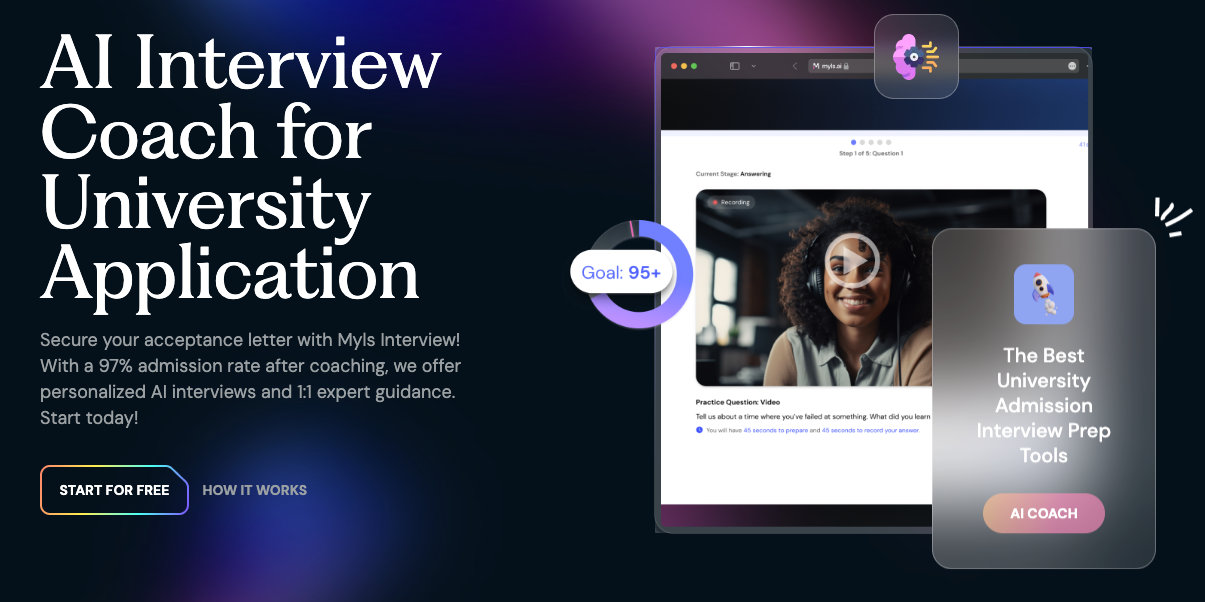
Myls Interview is designed to prepare students for undergraduate video interviews as they are actually evaluated by admissions committees.
The platform supports preparation through:
- Realistic video interview simulations with strict timing and recording
- Question types aligned with Canadian undergraduate admissions, including motivation, reflection, leadership, and ethics
- Structured and actionable feedback on clarity, structure, pacing, and authenticity
- Full video playback allowing students to assess delivery, tone, and body language
- Iterative practice cycles that reduce nervousness and improve consistency over time
- Progress tracking that shows measurable improvement across attempts
This approach helps students build confidence based on experience and performance, rather than memorization.
A Final Perspective on Undergraduate Video Interviews
Undergraduate video interviews are not casual conversations. They are structured evaluations designed to assess communication under constraint.
Strong academics open the door. Video interviews determine who walks through it.
Students who understand this and prepare deliberately gain a significant advantage. Those who rely solely on written preparation often underperform despite strong credentials.
If you want to practice real undergraduate video interviews the way admissions committees evaluate them, try Myls Interview for free to experience realistic interview questions with feedback aligned to how candidates are actually assessed.


