
Queen’s Smith Commerce Supplementary Application & Interview Guide
A comprehensive guide to the Queen’s Smith Commerce supplementary interview, covering format, evaluation criteria, question types, common mistakes, and strategic preparation.

Queen’s University Smith School of Business Commerce is one of the most competitive undergraduate business programs in Canada. Each year, a large number of applicants meet academic expectations, yet only a small proportion receive offers. This is because grades alone are not enough. The supplementary application and interview play a decisive role in admissions outcomes.
Queen’s Smith Commerce uses the supplementary interview to evaluate leadership potential, communication clarity, ethical judgment, and program fit within its collaborative learning environment. Many academically strong students struggle not because they lack ability, but because they are unprepared for how Smith Commerce evaluates responses under time pressure.
This guide provides a comprehensive explanation of the Smith Commerce supplementary application, including interview format, evaluation criteria, realistic question examples, assessment logic, and preparation strategy.
Queen’s Smith Commerce Supplementary Application Format
The Smith Commerce supplementary application typically consists of timed interview components, which may include video responses and short written answers. While specific formats may change slightly over time, several structural elements remain consistent.
Applicants are given limited preparation and response time, only one attempt per question, and no opportunity to revise answers after submission. Responses are evaluated based on reasoning, structure, and clarity, rather than polish or presentation quality.
This format intentionally discourages memorization. Instead, it rewards applicants who can quickly interpret questions, organize their thoughts, and communicate clearly under pressure. Preparation methods that simulate real interview conditions and provide targeted feedback therefore tend to produce significantly stronger outcomes.
What Queen’s Smith Looks for in Applicants
Understanding evaluation criteria is critical for strong interview performance. Queen’s Smith consistently assesses a set of core competencies across all interview questions, regardless of wording.
Leadership Potential
Leadership at Smith is not defined by titles or formal authority. Admissions officers evaluate initiative, responsibility, and influence within group settings. Strong candidates demonstrate leadership by taking ownership of outcomes, guiding discussions, and making thoughtful decisions even when information is incomplete.
Applicants who focus only on positions or titles often underperform compared to those who clearly explain how they influenced others, adapted their approach, or responded to challenges.
Communication Clarity
Clear communication is essential in Smith’s case based and discussion driven learning environment. Admissions officers assess how well applicants organize ideas, explain reasoning, and adapt explanations to strict time constraints.
Overly complex language or excessive detail can weaken otherwise strong responses. Smith consistently rewards clarity, logical flow, and concise expression, particularly in timed interview settings.
Reflection and Maturity
Reflection is one of the most important and most misunderstood evaluation criteria. Admissions officers look for evidence that applicants can assess their own decisions, learn from experience, and adjust their thinking.
Applicants who simply describe what happened without explaining what they learned or how their perspective changed tend to receive lower evaluations than those who demonstrate growth, self awareness, and intellectual maturity.
Ethical and Team Based Judgment
Smith’s collaborative culture places strong emphasis on professionalism and ethical reasoning. Applicants are evaluated on their ability to consider multiple perspectives, manage conflict fairly, and make balanced decisions.
Ethical questions are not designed to test morality. They are designed to assess judgment, reasoning, and professionalism under ambiguity, especially when time and information are limited.
Queen’s Smith Commerce Interview Question Examples
Although exact interview questions vary from year to year, the underlying competencies assessed remain consistent.
Personal Motivation and Program Fit Questions
Admissions officers evaluate authentic motivation, understanding of the Smith learning environment, and intentional program selection.
Strong answers reference case based learning, collaborative culture, and leadership development, and clearly explain why these elements matter personally.
Practicing with real past interview style questions helps applicants move beyond surface level explanations and demonstrate genuine program fit.
Leadership and Teamwork Questions
Admissions officers focus on decision making process, conflict resolution, and accountability, not authority or outcomes alone. Applicants who explain how and why decisions were made consistently outperform those who simply describe success.
Ethical and Situational Judgment Questions
Evaluation focuses on structured reasoning, stakeholder awareness, and professional tone. A strong response clearly identifies the issue, considers perspectives, proposes a balanced response, and reflects on responsibility.
Communication Under Time Pressure
Smith consistently rewards responses that are focused, logically organized, and clearly delivered, even when time is limited. Clarity and structure matter more than complexity.
How to Answer Queen’s Smith Interview Questions Effectively
Strong answers use a clear and repeatable structure. Brief context is followed by thought process, action taken, and reflection. The thought process and reflection components are particularly important.
Smith places greater value on reflection than achievement. Applicants who demonstrate learning, adaptability, and self awareness perform more strongly.
Time management is critical. High performing applicants signal structure early, allocate time intentionally, and conclude clearly. Practicing under timed conditions with actionable feedback is the most reliable way to improve.
Common Mistakes That Hurt Queen’s Smith Applications
Even strong candidates are rejected due to avoidable mistakes:
- Generic leadership stories with little decision making detail
- Over polished or memorized responses
- Weak reflection
- Poor time management
Avoiding these mistakes requires deliberate practice using realistic interview questions and clear performance diagnostics.
How to Prepare for the Queen’s Smith Commerce Interview
Effective preparation focuses on performance, not memorization. High impact preparation includes timed practice, structured speaking, and targeted feedback.
Reading example answers without applying them rarely leads to improvement. Smith interviews reward adaptability and structured thinking, which must be trained through realistic interview simulation.
Preparation Timeline and Final Checklist
Four to six weeks before, focus on understanding evaluation criteria and practicing core question categories.
Two to three weeks before, shift to full interview simulations and reflection improvement.
Final week, complete technical checks and light review, and avoid last minute memorization.
Final Perspective on Preparing for Queen’s Smith Commerce
Queen’s Smith Commerce interviews are designed to identify applicants who can think clearly, communicate effectively, and reflect honestly in a collaborative academic environment.
Applicants who prepare strategically using past questions, actionable feedback, detailed performance reports, and program relevance evaluation through Myls Interview gain a measurable advantage in one of Canada’s most competitive undergraduate admissions processes.
How Myls Interview Helps Improve Queen’s Smith Commerce Interview Outcomes
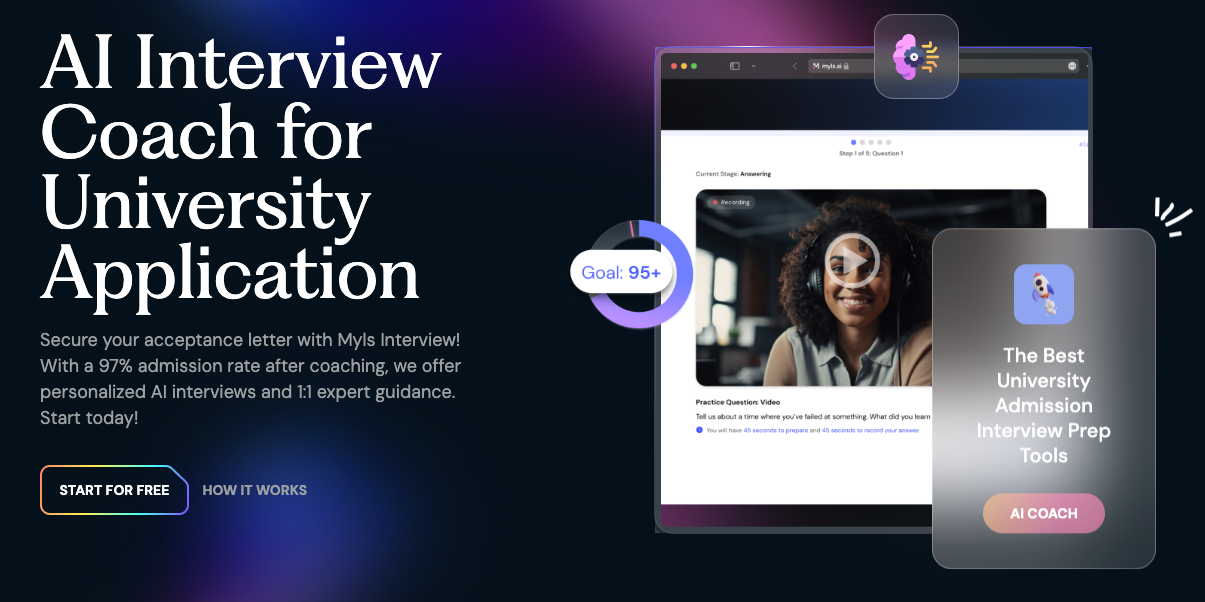
Preparing successfully for the Queen’s Smith Commerce supplementary interview requires applicants to demonstrate consistent clarity, structured reasoning, strong reflection, and program relevance under pressure.
Myls Interview is designed to replicate real university admissions interviews and help applicants improve systematically through the following features:
- University admissions video interview simulation, mirroring the structure, timing, and pressure of real Smith Commerce style interviews
- Practice with past interview style questions, based on historical patterns and expectations from Queen’s Smith Commerce rather than generic interview prompts
- Full response recording, allowing applicants to review their delivery, structure, clarity, and non verbal communication
- Comprehensive performance reports, with clear scoring across response structure, reasoning quality, communication clarity, and program relevance
- Program relevance evaluation, measuring how closely each response aligns with what Queen’s Smith actually looks for in successful applicants
- Actionable feedback on every attempt, identifying specific areas for improvement rather than general or vague comments
- Progress tracking across multiple practices, enabling applicants to see measurable improvement over time and build consistency under interview conditions
By combining realistic practice, detailed feedback, multi dimensional scoring, and program relevance analysis, Myls Interview helps applicants systematically improve interview performance and meaningfully increase their chance of receiving an offer!
If you are preparing for the Queen’s Smith Commerce supplementary interview, create a free account and start practicing real Smith style interview questions with Myls Interview today!


