
MIT Sloan MBA Interview and Supplementary Application Guide
The MIT Sloan MBA interview is a critical component of the admissions process. This guide explains the interview format, evaluation criteria, common question themes, and how candidates are assessed on analytical reasoning, execution mindset, measurable impact, and learning under pressure.

The MIT Sloan School of Management MBA is one of the most selective and analytically rigorous business programs in the world. Each year, applicants present exceptional academic backgrounds, strong quantitative skills, and impressive professional experience. However, admission decisions are not determined by credentials alone. The MIT MBA interview plays a critical role in identifying candidates who align with Sloan’s distinctive emphasis on data driven decision making, action orientation, and measurable impact.
MIT Sloan interviews are designed to evaluate how applicants analyze problems, translate insight into action, communicate with precision, and reflect on outcomes. Many highly qualified candidates underperform not because they lack intelligence or experience, but because they are unprepared for how Sloan assesses reasoning, execution, and impact under interview conditions.
This guide provides a comprehensive explanation of the MIT Sloan MBA interview, including interview format, evaluation criteria, realistic question examples, assessment logic, common mistakes, and effective preparation strategies.
MIT Sloan MBA Interview Format
The MIT Sloan MBA interview is typically behavioural, analytical, and impact focused. While interview logistics may vary by round or interviewer, the underlying assessment framework remains consistent.
Applicants are expected to discuss real professional experiences, often emphasizing how they identified problems, used data or evidence to inform decisions, and drove execution. Interviewers are less interested in abstract leadership theory and more focused on what applicants actually did, why they did it, and what resulted.
Key characteristics of the MIT Sloan interview format include:
- Structured behavioural questions
- Emphasis on past actions and outcomes
- Limited time to respond
- Evaluation of reasoning clarity and execution mindset
The format discourages generic storytelling. Instead, it rewards applicants who can clearly explain decision logic, quantify impact, and reflect on learning. Candidates who rely on broad narratives without concrete detail often struggle to meet Sloan’s expectations.
What MIT Sloan Looks for in MBA Applicants
MIT Sloan MBA evaluates applicants across a distinct set of competencies that reflect its management philosophy.
Analytical and Data Driven Thinking
Sloan places strong emphasis on evidence based decision making. Interviewers assess how applicants use data, frameworks, or structured analysis to guide choices.
Strong responses demonstrate:
- Logical problem decomposition
- Use of evidence or metrics
- Clear explanation of assumptions
Applicants who rely solely on intuition without analytical justification tend to underperform.
Action Orientation and Execution
Insight alone is not enough at Sloan. Interviewers look for candidates who can translate analysis into action and drive results.
High performing responses explain:
- How decisions were implemented
- What obstacles were encountered
- How outcomes were measured
Execution clarity matters as much as idea quality.
Comfort with Ambiguity
Many Sloan interview questions involve uncertain or complex situations. Applicants are evaluated on how they make decisions when information is incomplete.
Interviewers assess:
- Tradeoff awareness
- Adaptability
- Willingness to iterate based on feedback
The goal is not certainty, but sound judgment under uncertainty.
Communication Precision
Clear and concise communication is essential in Sloan’s fast paced learning environment. Interviewers assess how well applicants:
- Structure responses
- Avoid unnecessary detail
- Explain complex ideas efficiently
Overly long or unfocused answers weaken impact.
Reflection and Learning
MIT Sloan MBA values applicants who learn from outcomes, including failure. Reflection demonstrates intellectual honesty and growth mindset.
Responses that emphasize results without discussing learning tend to score lower.
MIT Sloan MBA Interview Question Examples
While exact questions vary, the competencies assessed remain consistent. The following examples reflect realistic MIT Sloan interview question patterns.
Motivation and Program Fit
- Why are you pursuing an MBA, and why is MIT Sloan the right environment for your goals?
- What aspects of Sloan’s approach to management most appeal to you?
Interviewers evaluate clarity of intent and alignment with Sloan’s analytical and action oriented culture.
Analytical Decision Making
- Describe a time when you used data or analysis to influence an important decision.
- Tell us about a situation where you had to make a decision with incomplete information.
Evaluation focuses on reasoning process rather than correctness.
Execution and Impact
- Describe a project where you turned analysis into action. What was the result?
- Tell us about a time you drove measurable impact in your organization.
Interviewers assess execution mindset, accountability, and results.
Leadership and Team Dynamics
- Describe a time you led a team through a complex or technical challenge.
- How do you handle disagreement when working with highly analytical teammates?
Strong responses emphasize communication strategy and decision logic.
Reflection and Learning
- Describe a project that did not achieve its intended outcome. What did you learn?
- Tell us about feedback that changed how you approach problem solving.
Interviewers look for growth and adaptability.
How to Answer MIT Sloan Interview Questions Effectively
High performing Sloan interview responses follow a clear and disciplined structure. Applicants briefly establish context, explain analytical approach, describe actions taken, quantify outcomes when possible, and reflect on learning.
MIT Sloan places greater value on how decisions were made and executed than on polished storytelling. Applicants who clearly articulate reasoning and impact consistently perform more strongly.
Effective time management is critical. Strong candidates:
- Lead with structure
- Focus on key analytical decisions
- Avoid unnecessary background
Practicing concise delivery under timed conditions significantly improves performance.
Common Mistakes That Hurt MIT Sloan Applications
Many applicants underperform due to avoidable issues:
Over storytelling without data
Narratives lacking evidence or metrics fail to demonstrate analytical strength.
Focusing on ideas without execution
Sloan values action. Insight without follow through weakens evaluation.
Overly technical explanations
Complex detail without clear takeaway reduces clarity.
Poor pacing
Unstructured responses that run long reduce impact.
Avoiding these mistakes requires performance based preparation, not passive review.
How to Prepare Effectively for the MIT Sloan MBA Interview
Effective preparation focuses on execution and clarity, not memorization. High impact preparation includes:
- Practicing analytical explanations aloud
- Structuring answers around data, action, and outcome
- Receiving targeted feedback on clarity and pacing
Reading sample answers without active practice rarely leads to improvement. MIT Sloan interviews reward structured thinking and decisive communication, which must be trained.
Preparation Timeline and Final Checklist
Four to six weeks before
Review evaluation criteria and practice analytical and execution focused questions.
Two to three weeks before
Shift toward full interview simulations and refining concise delivery.
Final week
Complete technical preparation and light review, while avoiding last minute memorization.
Final Perspective on MIT Sloan MBA Admissions
MIT Sloan MBA interviews are designed to identify applicants who can analyze rigorously, act decisively, communicate precisely, and learn continuously in complex environments.
Applicants who prepare strategically gain a meaningful advantage in a highly competitive admissions process.
How Myls Interview Helps Improve MIT Sloan MBA Interview Outcomes
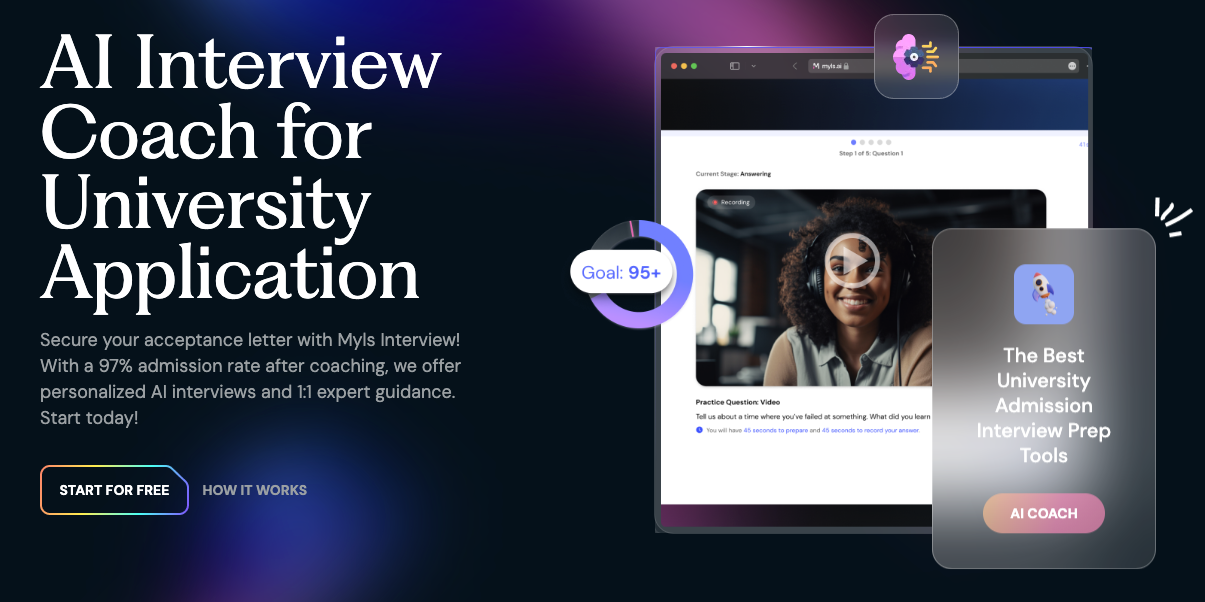
Strong MIT Sloan interview performance requires applicants to demonstrate analytical reasoning, execution mindset, communication clarity, and program alignment under pressure.
Myls Interview supports this preparation through:
- Graduate level admissions interview simulation aligned with MBA programs
- Practice with past interview questions reflecting Sloan evaluation patterns
- Customizable questions targeting analytics, execution, and leadership
- Full response recording for reviewing clarity and delivery
- Detailed performance reports with scoring and program relevance evaluation
- Actionable feedback on every attempt
- Progress tracking across multiple practice sessions
By combining realistic practice, targeted feedback, and program specific evaluation, Myls Interview helps applicants systematically improve interview performance and increase their chance of admission.


