
Kira Talent Video Interview: What It Is and How to Practice for It
Many competitive university programs use the Kira Talent video interview to evaluate applicants. Learn how it works, what types of questions are asked, and how Myls Interview helps you build the confidence and structure you need to succeed—without sounding scripted.

What Is the Kira Talent Interview?
The Kira Talent interview is an asynchronous video and written interview platform used by universities to evaluate applicants beyond grades and test scores. In Canada, Kira is widely adopted by highly competitive undergraduate programs, particularly in business, health sciences, and accounting.
Canadian programs that commonly use Kira include:
- Rotman Commerce at the University of Toronto
- Accounting and Financial Management (AFM) at the University of Waterloo
- Health Sciences at the McMaster University
- Sauder School of Business at the University of British Columbia (UBC)
- Smith’s Commerce at the Queen’s University (for select applicants)
Unlike live interviews, Kira requires applicants to respond to timed video and written prompts using a webcam and keyboard. Responses are recorded once and reviewed later by admissions committees.
This format is intentional. Kira interviews are designed to assess how applicants think, communicate, and reflect under time pressure, not how polished they sound after revision.
Why Canadian Universities Use Kira Talent
For programs such as Rotman Commerce, McMaster Health Sciences, and Waterloo AFM, academic averages are already high across the applicant pool. Kira exists because grades alone no longer differentiate candidates.
Kira Talent allows admissions teams to:
- Standardize evaluation by placing all applicants under identical timing conditions
- Observe real-time reasoning and communication, without editing or coaching
- Assess professional readiness, including judgment, reflection, and composure
In practice, this means the Kira interview often becomes the decisive stage of the admissions process.
Applicants who treat Kira as a “casual video” frequently underperform—not because they lack ability, but because they misunderstand what is being evaluated.
What to Expect From a Kira Talent Interview
Timed Video Response Questions
Most Canadian Kira interviews include several video prompts. For each question:
- A prompt appears on screen (sometimes read aloud)
- You receive 30–60 seconds to prepare
- You then have 1–2 minutes to respond on camera
- Most interviews include 2–4 video questions
Once recording starts, there are no pauses, edits, or retakes.
This is why applicants who rely on memorized answers often struggle. Under time pressure, scripted responses sound rigid or collapse entirely.
For example, an applicant who memorizes “I’m a strong leader” often freezes when asked why or how whereas an applicant who prepares experiences can adapt naturally.
Timed Written Response Questions
Some programs also include written prompts:
- Typically 1–2 questions
- Typed directly into the Kira platform
- Time limits usually range from 5–10 minutes
Written responses are evaluated for clarity, structure, and prioritization, not length or advanced vocabulary.
A strong response might briefly introduce a point, support it with a clear example, and conclude with reflection rather than attempting to cover multiple ideas superficially.
Technical and Environment Requirements
Because Kira is a one-time submission, technical readiness matters:
- Webcam and microphone
- Quiet, well-lit space
- Stable internet connection
- Neutral background and professional posture
University admissions committees do not separate “content” from “delivery.” Presence and professionalism are part of the evaluation.
What Types of Kira Interview Questions Are Asked?
Kira questions are rarely academic. Instead, they focus on behavioural and reflective competencies, such as:
- Self-awareness and maturity
- Leadership and teamwork
- Ethical reasoning and values
- Communication under pressure
- Program fit and motivation
For example, a question like “Tell us about a challenge you faced” is not testing resilience in theory. It is testing whether you can select a relevant experience, explain your actions clearly, and reflect on learning, all within 90 seconds.
Applicants who answer with vague statements such as “I learned a lot” or “It made me stronger” typically score lower than those who explain what changed in their behaviour afterward.
What Admissions Committees Are Really Evaluating
Although formal rubrics are rarely published, Kira interviews across Canadian universities consistently assess four core areas.
Communication Structure and Clarity
Can you organize your thoughts quickly and deliver a clear, focused response under strict time limits?
An answer that covers one strong idea with structure will score higher than an answer that attempts three ideas without depth.
Self-Awareness and Reflection
Strong applicants acknowledge limitations and growth.
For example, saying
“I initially underestimated the importance of time management, missed an early deadline, and adjusted by creating internal deadlines”
demonstrates far more maturity than claiming perfection.
Judgment and Values Alignment
Programs like U of T Rotman Commerce and Queen’s Smith Commerce look for ethical reasoning and accountability, not moral slogans.
An applicant who explains how they handled a difficult situation—such as addressing a teammate’s mistake respectfully to demonstrates judgment in action.
Presence and Professionalism
Tone, pacing, eye contact, and engagement matter. Kira reveals how applicants come across when speaking spontaneously.
This is where many academically strong applicants lose points, they sound competent, but disengaged or overly cautious.
How to Prepare Effectively for a Kira Talent Interview
Effective Kira interview preparation focuses on performance, not memorization.
Applicants who perform well:
- Understand exact timing constraints
- Practice structured but flexible responses
- Use specific examples, not generic claims
- Train under realistic, timed conditions
For instance, instead of preparing the sentence “I’m a strong leader,” strong candidates prepare experiences they can adapt, such as leading a club fundraiser, resolving conflict in a group project, or managing responsibilities under pressure.
How Myls Interview Helps You Succeed in Canadian Kira Interviews
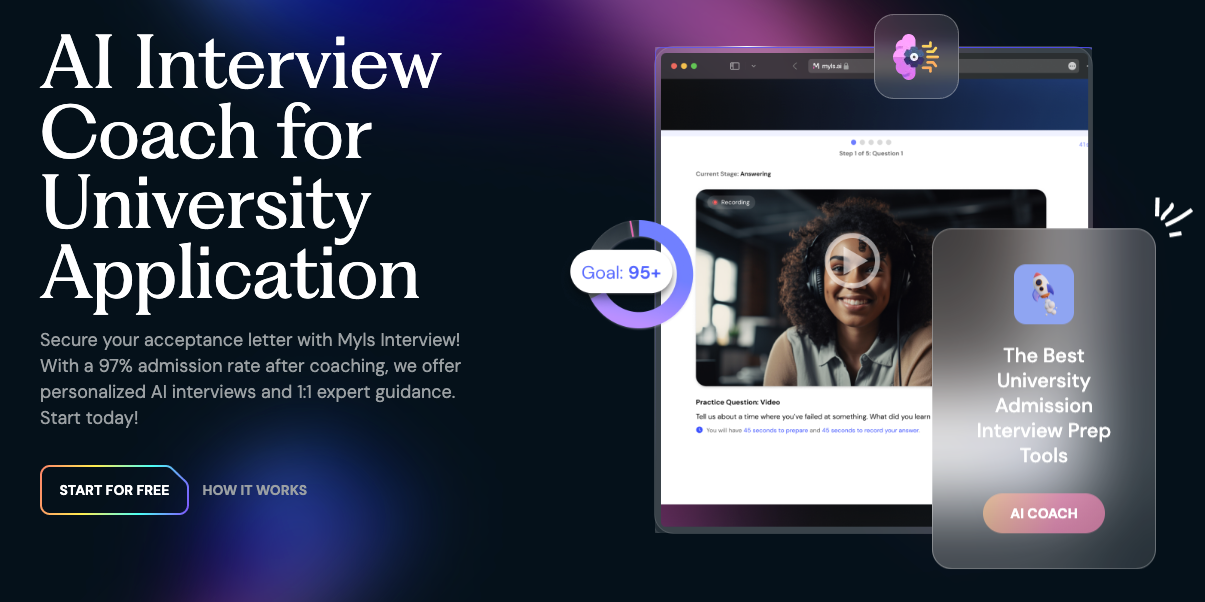
Myls Interview is built specifically around how Kira Talent interviews are evaluated by Canadian universities, not just how the questions appear.
True-to-Format Kira Simulation
Myls Interview replicates the exact mechanics used by top competitive programs that rely on the Kira Talent interview.
- Timed question display
- 30–60 second preparation windows
- 1–2 minute webcam recordings
- One-take responses with no retries
- Timed written response practice
This trains applicants to manage structure, timing, and composure simultaneously, which casual practice cannot replicate.
Performance-Based Feedback on Delivery
Most applicants never receive feedback on how they appear on camera.
Myls Interview provides actionable insights on:
- Response structure and clarity
- Pacing and time management
- Filler words and verbal habits
- Tone, confidence, and engagement
- Written response organization and grammar
This helps applicants correct issues such as rushing conclusions, hesitating excessively, or sounding rehearsed.
Identification of Kira-Specific Failure Patterns
Through repeated simulations, Myls Interview helps applicants identify recurring weaknesses, such as:
- Trying to cover too many points in limited time
- Repeating the prompt instead of answering it
- Hesitating to commit to a position
- Running out of time without reflection
Once identified, these patterns can be deliberately corrected.
Mentor Coaching for Program-Specific Strategy
Applicants can work 1 on 1 with experienced mentors who have successfully guided candidates through Kira interviews for Canadian programs.
Mentors help applicants:
- Select strong, adaptable examples
- Build flexible response frameworks
- Adjust tone for professionalism without stiffness
- Understand what specific programs value
This is especially valuable for applicants targeting U of T Rotman Commerce, Queen’s Smith Commerce, McMaster Health Sciences, and Waterloo AFM.
Alignment Across the Entire Application
A strong Kira interview should reinforce, not contradict and other parts of the application.
Myls Interview helps applicants align their Kira responses with:
- Resume themes
- Supplementary essays
- Academic and career goals
Admissions committees experience the application as one coherent narrative.
Final Perspective: Why Kira Interviews Eliminate Strong Applicants
Kira Talent interviews are designed to be diagnostic, not comfortable.
Applicants who rely on intuition or memorization often underperform. Those who train realistically with timing, feedback, and reflection that consistently outperform peers with similar grades.
Prepare for Canadian Kira Talent Interviews
Kira interviews reward clarity, structure, and authenticity under pressure.
Myls Interview helps you train exactly those skills, using realistic Kira simulations, performance-based feedback, and expert mentorship aligned with Canadian university admissions standards.
Sign up for free to practice Kira-style interviews and prepare with confidence.


