
How to Make a Short Video Introduction That Leaves a Big Impression
Learn how to create a strong short video introduction for university applications. Step by step guidance, examples, and practice tips for Canadian programs.

In today’s highly competitive university admissions environment, an increasing number of top programs require applicants to submit a short video introduction, typically ranging from 60 to 90 seconds, as part of their supplementary application. These video submissions are no longer optional or informal. They are deliberate assessment tools used to evaluate qualities that grades, test scores, and essays cannot fully capture.
Universities use short video introductions to assess communication clarity, professional presence, self awareness, and fit with the program’s learning culture. Competitive programs such as Ivey AEO, University of Toronto (U of T) Computer Science, University of Toronto (U of T) Architecture, Rotman Commerce, and McMaster Health Sciences increasingly rely on video responses to differentiate among academically strong candidates.
This guide provides a comprehensive breakdown of why short video introductions matter, what admissions committees evaluate, how to structure your response, and how to prepare strategically using performance based video practice, human coaching, and AI supported feedback.
Why Short Video Introductions Matter in University Admissions
Short video introductions simulate real world communication environments. In academic and professional settings, success often depends on the ability to explain ideas clearly, respond under time pressure, and communicate with confidence and maturity.
Admissions committees use video introductions to evaluate:
- Verbal communication skills
- Composure under constraints
- Ability to organize thoughts quickly
- Professional tone and presence
- Authenticity and reflection
While transcripts reveal what you have achieved, video introductions reveal how you think and present yourself. This distinction is critical when programs receive thousands of applications with similar academic profiles.
A well executed video introduction can significantly strengthen an application by making the candidate memorable, credible, and human.
What Admissions Committees Are Really Evaluating
Despite appearing informal, video introductions are scored against consistent evaluation criteria across programs.
Admissions reviewers typically assess:
- Clarity of communication
- Logical structure
- Relevance of content
- Self awareness and reflection
- Alignment with program values
- Energy and engagement
Importantly, reviewers are not evaluating acting ability or charisma. They are evaluating whether an applicant can communicate ideas clearly, professionally, and authentically under mild pressure.
Candidates who attempt to impress with complexity or over scripting often underperform compared to those who prioritize clarity, structure, and sincerity.
How to Structure a Strong Short Video Introduction
A strong video introduction follows a simple, repeatable structure that allows applicants to stay focused while sounding natural.
The most effective structure consists of three intentional phases:
- Opening Hook
- Core Message
- Purposeful Close
Opening Hook: Capture Attention Immediately
The opening seconds of your video are decisive. Admissions reviewers form initial impressions quickly, often before content is fully delivered.
Avoid generic openings such as “Hello, my name is” or “Thank you for this opportunity”. These waste valuable time and do not convey insight.
Instead, begin with a specific experience, realization, or motivation that immediately signals curiosity, initiative, or reflection.
For example, describing how a failed project reshaped your interest in a field demonstrates growth and learning, which is more compelling than listing accomplishments.
Strong openings are concrete, personal, and relevant.
Core Message: Communicate What Matters Most
The middle portion of your video should focus on who you are, what drives you, and why this program fits your goals.
This is not a place to repeat your resume. Admissions committees have already reviewed your academic record. Instead, explain:
- What excites you intellectually
- How key experiences shaped your interests
- What you value in a learning environment
- How you contribute to collaborative communities
For instance, rather than stating “I am a strong leader”, describing how you navigated disagreement in a group project and what you learned demonstrates leadership, judgment, and communication without self labeling.
Applicants who articulate learning and reflection consistently outperform those who list achievements without insight.
Purposeful Close: End With Direction
A strong conclusion reinforces intentionality and readiness.
Avoid formulaic thank you statements that add little value. Instead, close by expressing forward looking motivation, such as enthusiasm for challenge, growth, or contribution.
Effective closings leave reviewers with a clear sense of direction, not repetition.
Common Mistakes That Weaken Video Introductions
Even academically strong applicants lose points due to avoidable errors:
- Sounding scripted or memorized
- Running out of time before finishing
- Poor lighting, framing, or audio
- Flat or monotone delivery
- Trying to cover too many ideas
These mistakes signal lack of preparation, not lack of ability.
Video introductions reward practice under realistic conditions, not last minute recording.
How to Prepare Effectively for Video Introductions
Effective video interview preparation is performance based, not passive.
Strong preparation strategies include:
- Writing bullet point outlines, not scripts
- Practicing responses under exact time limits
- Recording and reviewing delivery
- Seeking structured feedback
- Practicing multiple variations of the same prompt
Applicants who practice only once often sound unpolished. Those who practice repeatedly with feedback develop fluency and confidence.
Why Practice Without Feedback Is Not Enough
Many applicants practice by recording themselves and self reviewing. While useful, this approach has limits.
Without external feedback, applicants often:
- Miss unclear phrasing
- Underestimate pacing issues
- Fail to notice distracting habits
- Overestimate clarity
This is why guided feedback, especially from people familiar with admissions expectations, produces significantly better outcomes.
How Myls Interview Helps Applicants Perform at a Higher Level
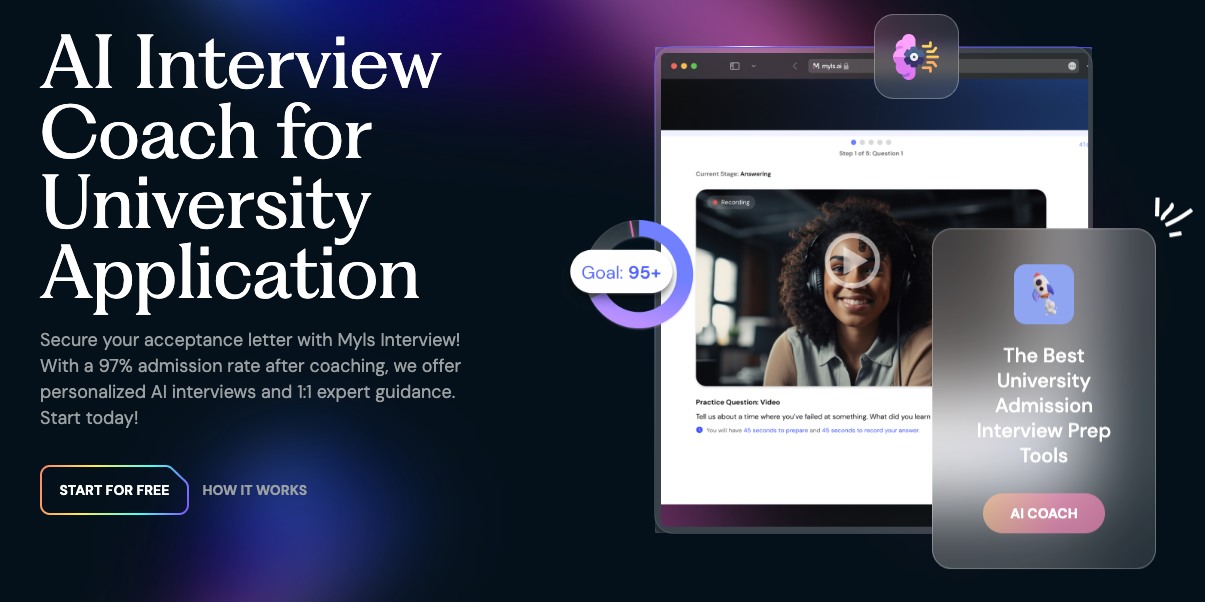
Myls Interview is designed specifically to help applicants excel in short video introductions and asynchronous university video interviews, including formats used by Canadian universities.
Rather than focusing on memorization, Myls Interview trains communication performance under realistic constraints.
True to Format Video Practice
Myls Interview replicates the exact mechanics used by competitive programs, including:
- Timed preparation windows
- One take video recording
- Strict response limits
- Written response simulations when applicable
This ensures applicants build comfort with real video interview conditions, not artificial practice.
AI Driven Feedback and Performance Insights
Applicants receive immediate AI based and actionable feedback on:
- Clarity and pacing
- Tone and engagement
- Filler word usage
- Structure and coherence
- Written response organization
This allows applicants to correct issues quickly and objectively.
1 on 1 Mentor Coaching
Applicants can work 1 on 1 with experienced mentors who have successfully guided candidates through Kira Talent and program specific video interviews for Canadian universities.
Mentors help applicants:
- Understand what admissions teams look for and how programs evaluate fit
- Select strong personal examples
- Refine story framing
- Improve delivery and presence
- Align responses with program values
Confidence Building Through Repetition
Confidence in video interviews does not come from talent. It comes from repetition under realistic conditions.
Myls Interview allows applicants to practice repeatedly while tracking improvement across attempts, turning anxiety into familiarity.
Final Perspective: Why Video Introductions Matter More Than Ever
Short video introductions are no longer experimental. They are a core component of modern admissions evaluation.
Applicants who approach them casually often underperform. Those who prepare strategically gain a meaningful advantage.
In 60 to 90 seconds, admissions committees evaluate communication maturity, clarity of thought, and professional readiness.
With the right video interview preparation, video introductions become an opportunity to humanize your application and differentiate yourself meaningfully.
Ready to Practice Smarter
A strong video introduction is not about perfection. It is about clarity, authenticity, and confidence under pressure.
Myls Interview helps applicants practice the right way, receive the right feedback, and perform at their best when it matters.


