
Graduate Video Interview Guide for Global Master’s Admissions
Graduate video interviews are now a core part of global master’s admissions. This guide explains what universities actually evaluate, why strong applicants fail, and how to prepare for graduate video interviews with clarity, judgment, and professional confidence.

The Rise of Video Interviews in Graduate Admissions
Across global graduate admissions, video interviews have evolved from a secondary screening tool into a core decision making mechanism. Universities now rely heavily on asynchronous and structured video interviews for a wide range of masters programs, including business, finance, accounting, analytics, management, and economics.
This shift is not driven by convenience alone. Graduate video interviews allow admissions committees to assess dimensions of readiness that cannot be inferred from transcripts, resumes, or written statements.
As a result, many applicants who appear exceptionally strong on paper are rejected at the interview stage, often without understanding why.
Why Strong Academic Applicants Are Most at Risk
Counterintuitively, it is often the strongest academic applicants who struggle the most in graduate video interviews.
High achieving candidates are accustomed to environments that reward precision, correctness, and technical depth. Video interviews evaluate something fundamentally different: clarity of judgment, communication maturity, decision making under pressure, and professional readiness.
Applicants who fail to recognize this shift often prepare in ways that actively undermine their performance. They focus on perfection rather than prioritization, completeness rather than clarity, and accuracy rather than judgment.
Where the Video Interview Fits in Masters Admissions
Across Canadian and international universities, the admissions sequence typically follows a consistent structure.
Admissions committees review academic transcripts and prerequisites, evaluate quantitative or disciplinary preparation, assess personal statements, resumes, and references, and then introduce the graduate video interview as a final filter.
By the time applicants reach the interview stage, universities have already concluded that they are academically capable of completing the program.
The interview is not asking whether the applicant is qualified. It is asking whether the applicant is ready to function as a graduate level professional in the environments the program prepares them for.
This distinction explains why technical excellence alone does not translate into interview success.
What Universities Are Actually Evaluating in Graduate Video Interviews
Although universities rarely publish formal rubrics, evaluation logic is consistent across Canadian, UK, US, and global masters programs.
Graduate video interviews primarily assess professional judgment and decision making, clarity of explanation under time constraints, ethical awareness and responsibility, communication maturity and composure, reflection and learning mindset, and motivation and program fit.
Technical knowledge is assumed. The interview evaluates how applicants apply, prioritize, and communicate that knowledge when time, information, and certainty are limited.
Why High Performing Candidates Fail Video Interviews
Failure patterns repeat across hundreds of graduate programs with remarkable consistency.
Many applicants treat the interview like an exam. They prepare as if correctness and depth will be rewarded. Video interviews do not reward completeness. They reward structured prioritization and clarity.
Others deliver overly technical or misaligned responses. Applicants default to jargon or complex frameworks when the question requires explanation, judgment, or reflection. This creates distance rather than credibility.
Hesitation is another common issue. Fear of being wrong leads to excessive caveats, weak conclusions, or indecision. In professional contexts, this signals uncertainty rather than thoughtfulness.
Scripted delivery also undermines performance. Highly rehearsed answers often collapse under time pressure and recording stress. Delivery becomes rigid, rushed, or unnatural. Video interviews reward authentic structured thinking, not memorization.
Why Writing Perfect Answers Rarely Works
Many graduate applicants prepare by writing complete answers in advance. While this clarifies ideas, it creates dependency on phrasing.
When candidates attempt to recall written responses verbally, structure degrades under pressure and delivery becomes unnatural. Effective preparation trains thinking patterns and response frameworks, not scripts.
Common Graduate Video Interview Question Types
Across business, finance, accounting, analytics, and management programs, universities rely on a small set of question categories.
Applicants are commonly asked motivation and program fit questions, ethical or judgment based scenarios, explanation tasks that require translating technical ideas to non technical audiences, reflection on feedback failure or growth, and leadership or teamwork prompts.
These questions are intentionally broad. They are designed to reveal how candidates think and communicate, not what they know.
What High Scoring Graduate Video Interview Responses Share
Strong responses share the same characteristics across institutions.
They establish clear structure from the opening sentence, engage the question directly, use an appropriate level of detail, commit to defensible decisions, maintain a calm professional tone, and demonstrate reflection and learning.
Notably, the highest scoring responses are rarely the most complex. They are the most clear, deliberate, and grounded.
How to Prepare Effectively for Masters Video Interviews
Effective preparation must be performance based.
Applicants need to practice speaking under strict time limits, structuring responses without written prompts, explaining ideas to non specialist audiences, managing composure on camera, and reviewing recordings to identify habits and weaknesses.
Preparation that avoids real execution leaves critical gaps.
How Myls Interview Solves the Graduate Video Interview Problem
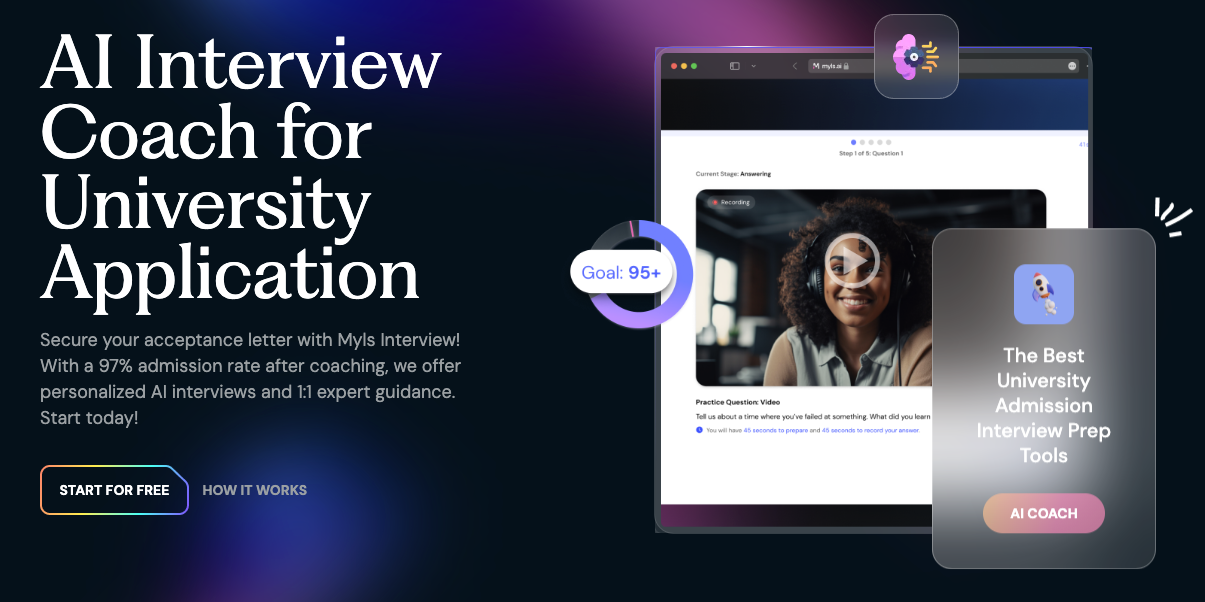
Myls Interview is built around how graduate admissions committees actually evaluate video interviews, not generic interview advice.
Myls Interview provides program aligned video interview simulations across business, finance, accounting, analytics, and management programs. Applicants practice under strict timing conditions that mirror real interviews.
Evaluation focuses on judgment, clarity, communication maturity, and professionalism, rather than superficial delivery. Structured and actionable feedback highlights common graduate interview failure patterns, including over technical answers, hesitation, lack of prioritization, and unclear reasoning.
Applicants receive full response recordings and playback for self review, enabling awareness of pacing, tone, and structure. Iterative practice allows measurable improvement across sessions, replacing guesswork with targeted performance development.
Final Perspective for Graduate Applicants
Masters video interviews are not designed to reward intelligence alone. They are designed to identify applicants who can communicate responsibly, apply judgment clearly, and operate professionally under pressure.
Strong academics open the door. The video interview determines who advances.
Applicants who understand this distinction and prepare accordingly gain a meaningful advantage across Canadian and global graduate programs.
Practice Graduate Video Interviews the Right Way
Graduate video interviews test judgment, clarity, and professional readiness. Try Myls Interview for free to practice realistic masters level interview questions and receive feedback aligned with how universities actually evaluate candidates.


